

One of the basic skills that’s used by watchmakers all the time, is sharpening their tweezers and sharpening their screwdriver blades so they properly fit the screws. In this video I will show you how to do this simple task, making you a better watchmaker.
Learning Basic Watchmaking Skills
Today we’re going to be talking about one of the skills and habits that all people getting into watchmaking should be familiar with and that’s having properly dressed tweezers and screwdrivers. You should learn this, before you even take the first screw out of a movement, and it will save you from having a really bad day.
Even when you buy brand new tweezers, the chances are, the tips aren’t going to be in the condition that you need them to be in to be able to pick up the smallest parts of the watch movement.
Important: When available, we use affiliate links and may earn a commission!
What damaged Watchmaking Tweezers look like
Here we have an example of two different tweezers. The one on the left is an example of a properly shaped or dressed set of tweezers.

Notice that the tips are identical, they’re even at the end and when the jaws are closed, they come down flat and there’s no gap between them. The pair on the right obviously have been dropped. You can look at the bottom tip, which has been broken off and the upper tip is actually bent upwards. This is what we call duck billing.
When you have duck billing or when the tips of your tweezers do not close flush with each other, it makes it extremely difficult to pick up small parts. Luckily, you do not need a whole lot of tools to reshape or dress a pair of tweezers.
The first thing you are going to need is a sharpening stone.

This is the one that I also use for dressing screwdrivers. Having having some 400-grit sandpaper and Rodico also comes in handy.

Sharpening Watchmakers Tweezers
A pair of tweezers has five sides that can be sharpened. You have two edges, the top, bottom and of course the tips. Now to sharpen the edges you just put them on your sharpening stone and you put a little pressure on the front tip and you make long strokes across the sharpening stone.

The key here is to do the same amount on each side. As you shape the top and the bottom of the tweezer, just use a rolling motion with your wrist as you go across the sharpening stone. Just remember to use the same number of strokes on each side of the tweezer.

Depending on how damaged your tweezers are, it might require 10, 20 or 30 strokes across the sharpening stone. You will just have to play that by ear.
As far as lubricating the sharpening stone, some people use spit, some people use water, but I use a couple drops of clock oil, wiping it across the stone with my finger. Just remember to try to keep even pressure on the tips, making slow deliberate strokes across the top of the stone.
As you are sharpening, you are going to get a little grit build up.
I like to just use a little pinch Rodico to clean off the tips of my tweezers as I’m going along so that I can inspect them. Now we need to get the tips even.
Evening out the tips
There are a couple of ways to do it. You can just draw the tip of your tweezers, holding them at a 90 degree angle to the stone and just give it a couple swipes.
Another option is to use a piece of 400 grit sandpaper which is usually what I do because it’s a little less aggressive. All you really need to do, is make sure that the tips are even.After you sharpen them, how do you know if your tips are ready ?


The most effective way to check is by picking up some ridiculously small parts. Here we have some shepherd hook springs. These springs are only about fifteen hundredths of a millimeter thick so if you can pick up shepherd hook springs, that’s a pretty good indication that your tweezers are now in good enough condition to start working on a watch.

Another method is simply picking up end stones.
If you can pick up end stones with a pair of tweezers, you’re good to go.
Sharpening watchmakers’ screwdrivers
Let us take a look at sharpening and repairing a screwdriver tip.
You can clearly see that the end of the blade has been broken off and this is potentially going to either damage a screw or damage the movement.

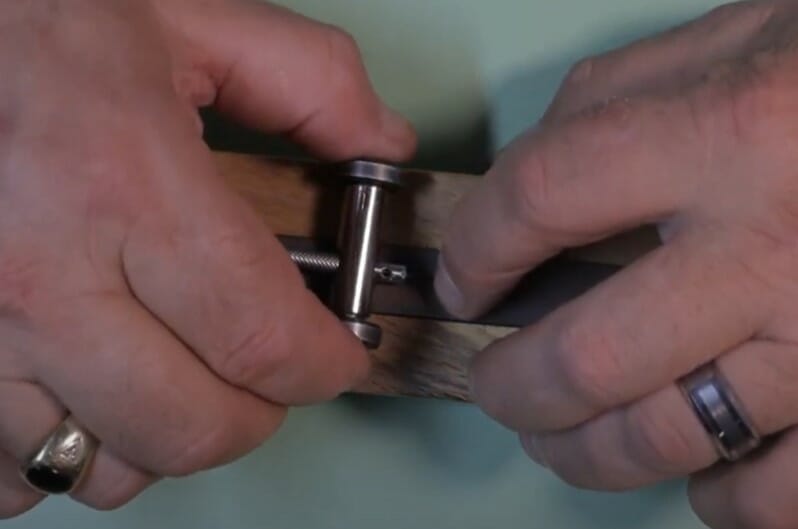
One thing you will want to get, is a screwdriver holder.
They are pretty inexpensive, probably about eight or nine bucks and it’s used to hold the screwdriver when you are sharpening it on the stone. You just press it together, insert the screwdriver and it clamps down and holds it.

With the screwdriver mounted in the holder, the first thing we need to do is get the flat side of the blade down flat to the sharpening stone. I find the easiest way to do this is just by squeezing in on the jig and then pushing down on the blade with my finger and that gets it flat.
If this is your first time I’d probably recommend taking a sharpie and just marking both sides of the blade with the black ink that way as you’re sharpening it, you can check the angle to make sure that it’s sitting flat so you’re not over sharpening the blade.


In this close-up you can clearly see that the blade’s not in the holder far enough. If you try to sharpen it like this, what you’re going to end up is with a chisel point.

In this close-up you can see that the screwdriver is actually too far into the jig and what’s going to happen is, you’ll be able to sharpen it but you’re going to be doing twice the work that if it was sitting at the correct position.
This is the correct position.

The blade of the screwdriver is sitting flat on the stone. Similar to sharpening tweezers, when you’re sharpening or removing damage from a screwdriver blade you want to apply a small amount of pressure to the tip of the screwdriver as you draw it across the sharpening stone.
How many strokes it’s going to take really depends on how much damage it has but the other reason that we dress screwdrivers is to make sure that they fit the slots properly.
You can see the screwdriver blade after ten swipes across the sharpening stone on each side.

You’ll notice that all the sharpie has come off and what we’re seeing is a shiny surface and we know we’re not changing the profile of the blade.
Checking our blade once again now we can see the damage has been removed but there is still a little bit roughness on the edge but that’s not going to matter.

Looking at the side view

you can just see how thin the tip is and that’s obviously too thin for a screwdriver slot. All we need to do now is square off the tip of the screwdriver blade. What I like to do is just keep a piece of 400 grit sandpaper on my bench and I use that to flatten the tip.

I find it’s a little less aggressive than a sharpening stone and I get very good results plus I’m able to control the depth of the screw in the slot easier. Keep a piece of Rodico handy so you don’t transfer any grit to the screw slot.
Fitting a screwdriver to the screw slots
Fitting a screwdriver to the screw slots is one of those tasks that you do on a daily basis in watchmaking. It is every bit as important as washing the parts after you do your disassembly or lubricating the jewels. Basically, what we’re referring to when we talk about fitting the screwdriver to the slot, is we want the screwdriver blade to be tight to the shoulders of the screw slot without the screwdriver touching the bottom of the slot.
Looking at it from top down view,

you can clearly see how much extra room the screwdriver has inside this screw slot and that’s primarily because the screwdriver tip is too deep in the slot. This is a very easy fix and we’re going to do that with some 400 grit sandpaper.
Sizing the tip to the screw slot
Holding your screwdriver at a 90 degree angle, just make a couple swipes and then check your screw tip again. this is not a lengthy process.
Now that we’ve taken a little bit off the tip of the screwdriver

you can see that the screwdriver goes deeper into the slot and the sides of the screwdriver blade come in contact with the shoulders of the screw giving us proper torque and safety.
Pro Tip
One of the ways to lessen the chance of a part getting pinged off your tweezers and flying into oblivion is by having the tips of your tweezers adjusted to the right width.

This is a very easy thing to accomplish by holding the tweezers in your hand, putting your thumbs together and then lightly bending on the spine of the tweezer which will actually bring the tip of the tweezers so they’re actually closed.
Then what you can do is just gradually and slowly pull them apart until you get the right amount of opening between the tips.

Another reason that parts ping off and get lost is because you’re putting too much pressure on the part as you’re picking it up. You do not have to really clamp down much. The instinct is typically to hold it tight so it doesn’t get lost but that is actually the thing that you don’t want to do. You should only pick it up enough to hold it so if it drops, it just falls straight down.
Another exercise you can do to improve your tweezer skills is by picking up end stones. Practice picking them up, turning them over and again only use the lightest amount of pressure. if you drop one you just want it to fall straight down. You do not want it to ping off in the distance.