

If you’re new to watchmaking, or even if you’ve been at it for a while, you know that finding watch parts is not only frustrating, but it can be very time consuming.
To start looking for parts for a wristwatch or pocket watch, the first thing you have to know is what the movement is, inside the watch.
So today I’m going to share with you a process that you can use to identify unknown watch movements. I’m going to give you my best tips for determining the part number, as well as where to go to source the parts for your projects
Just remember, finding watch parts is all about information, and information is king.
Important: When available, we use affiliate links and may earn a commission!
How to Identify a Watch Movement or Watch Caliber
You know, to even begin looking for a part for a watch, you first have to know what the caliber is that you’re dealing with.
The Swiss and Japanese makers will either have their name on the bridge, or the rotor, or even a maker’s mark stamped on the main plate by the balance wheel. Sometimes they’ll even put it on the dial side.


Identifying American Pocket Watches Movements
Early American pocket watches are identified by a model number or a grade number.
So you simply just go to the pocket watch database, you enter the name of the manufacturer, and the serial number. That will give you the model number, when it was manufactured, and just everything that you could possibly want to know about it. You can also see when the movement was made.

American Pocket Watch Movements Are Known as a Grade
American pocket watch movements are referred to as a Grade and not as a Caliber. There will also be different model numbers, which are just variations of the grade.
Pocket Watch Database Part Numbers
Now in the left column, you can click on the parts tab, and you’ll find a ton of information. You can find part numbers, as well as propagated links from eBay showing those parts.

Now it’s always a good idea to cross reference these numbers from other sources whenever possible.
Buying Watch Parts From eBay
Not all eBay sellers know what they’re selling. Sellers will not guarantee watch parts even when they from new old stock.
You also want to be careful with certain parts like new old stock mainsprings, as an example, considering these are typically 70 years old or more.
Old mainsprings do have a tendency to break, and if you are going to use one, you need to take it out of the ring, clean it, and re-lubricate it, otherwise it’s going to hurt your performance and amplitude.
Identifying Unmarked Movements
You can visit a website called Mikrolisk if the movement is unmarked but there is a name on the dial. This is a database of trademarks and trade names.

Just as an example, if we had a watch with Asa on the dial, we could search for it in the database, and quickly see that the manufacturer is Adolph Schild, so we can assume that the movement is an AS caliber movement.

So now that we know who made the movement, we could go back to Ranfft, and search for AS, and you will see all the AS calibers in Dr. Ranfft’s database.
Narrow down the search on Ranfft
Now the data number on the right is the Swiss ling size. Measure your watch’s diameter and convert it into the Swiss ling measurement.

Then you can search only for calibers that are the right size. You can also filter by automatic or manual wind movements, depending on what you’re trying to identify.
Import Codes used to Identify Watch Movements
Another option would be to look for an import code on the movement. Swiss movements were required to have a three letter code stamped on the movement. This showed that it was a Swiss import. That way the US could collect a little bit of tariff tax money. This was as attempt to level out the playing field for the American companies.

When you look up this import code, usually it’s going to give you the manufacturer’s name. Sometimes it’s going to be the company that’s actually doing the importing.

So again, with this information, that will at least identify the maker of the movement. But sometimes it’s just going to be an import company, which really won’t help you.
Once you identify the company that’s importing it, then you can go back to Ranfft database. You can search for the manufacturer’s name to see the movements associated with it.
Ranfft Advanced Search Options
Ranfft also has an advanced search option. This is where you could go in and tick off things like the shape of the movement, the shape of the regulator arm, the location of the winding stem.
It will search for everything that you’ve checked off. Then you could just kind of go through those movements to see if any of those look like the watch you have.

Sourcing Swiss Parts before Makers Marks
Prior to the use of maker’s marks by the Swiss, there were parts some available to watchmakers.
The problem was that watchmakers didn’t know what the caliber was, so they couldn’t order those parts.
Differences in the Swiss Movements
When you look at the watchmaker side of from this time period, they all pretty much look the same.
How the Keyless works were made is what was different from one movement to another. Watchmakers customized the keyless to make their watch movements unique, primarily so they didn’t run into copyright or patent issues.
The Bestfit Catalog for Watch Parts
To help the watchmakers, one of the largest suppliers at the time called BestFit, created a whole section of their catalog where the different keyless parts were outlined.
This section identified the manufacturer and the actual caliber so that a watchmaker could identify what they were working on.

The Bestfit Catalog enabled watchmakers to identify Swiss movements with no makers marks.
Fingerprinting a Watch Movement for Identification
We call this form of identification fingerprinting. You are comparing the keyless works on your movement to the illustrated drawings in the catalog. It’s really one of the last ways that you can identify a movement.

If you’ve exhausted everything else and you still can’t figure it out, then it’s probably not going to get figured out.
The Best Fit catalog is absolutely a must if you’re going to be working on any older Swiss movements.
What are Ebauche Numbers?
Part sheets have been around ever since parts were available to watchmakers. They use standardized numbers called Ebauche numbers to identify the parts on the sheet for that caliber.
These numbers are generic numbers, not really part specific numbers like we think of on modern technical sheets.
When searching for parts using Ebauche numbers, you want to use the manufacturer’s name, the caliber, the part name, and the Ebauche number in your search.
Now you can just search the internet looking for parts or technical sheets by typing in the caliber number technical sheet and a lot of times that will produce results.
Watch Part Sheets
Cousins UK
You can to Cousins UK, which is a great source not only for watch parts but for many hard to find technical sheets.
Just type in the manufacture and the caliber of the movement you’re looking for and then scroll down on the right sidebar to see if it’s available.
Seiko Parts Sheets
Now to find Seiko technical sheets, you just go to Seiko Service USA and you should be able to find what you’re looking for there.
Part Sheets for American Pocket Watches
For American pocket watches, part sheets are available with the model number and great information at pocket watch database and then you have AWCI, which is the American Watchmaker Clockmaker Institute, which has one of the largest databases of tech and part sheets available to their members.
Manufactures Watch Part Catalogs
Now for my money, the best option for parts numbers is using books directly from the manufacturer.

This is an Elgin watch part catalog that has every part number for almost 700 different movements. It also allows you to see what other grades or calibers that part is interchangeable with.
E&J Swigart Parts Catalog
Now for American pocket watches, the Illustrated Manual for American Watch Movements by E & J Swigert is my go-to for part numbers as well as mainspring information. They even have Bulova watch part interchangeability.
Marco Watch Part Catalog
Marco is a free digital catalog originally put out by the CE Marshall company. It is an absolute treasure trove of information, not only on movement parts, but it has dial illustrations as well as hand sizes.
The Marco catalog is something like 800 pages and not only do they have information about watch parts, but all kinds of things like makers marks and import codes.

Jules Borel Database for Watch Parts
Jules Borel & Co is by far one of the most important sources for identifying part numbers and sourcing vintage watch parts.
Using the Database
To start, click on the JBC database link, enter the makers three letter code and then the caliber number.

This will bring up the caliber number if it’s in the database. Then by clicking on the caliber number, that will pull up all the parts for that movement.

Just note that the prices listed are not going to be accurate. When you click on the part that you need, it’s going to take you to another page. At the very top it shows you what the part number is and then it also shows you all the other movements that use that same part.

Helps you Source Parts Watches
This is extremely useful. If you are you’re looking for a “parts watch” for a particular movement, it’s going to show you all the other Seiko movements that use that exact same part.
If you can’t find a 7002 caliber, you can use these other movements to source that part.
Search the Jules Borel Website for Parts
You simply copy the part number, then you go back to their main website and paste that part number in the search window. This will pull up the part with its current price and whether or not it’s in stock or not.
Now what you have to realize about this database is that any movement or any part that’s in there, that means that one time or another they’ve had those parts, but certain parts just get eaten up because there’s a lot of people working on watches and they don’t make most of these parts anymore.
Parts Availability
Companies like Jules Borel, buy up estates from watchmakers so they’ll bring in new parts all the time.
So even if a part wasn’t available the first time you looked a month down the road or whatever, they may have that part again.
Now even if they don’t have the part, you have the part number. So now you can use that part number to search with other watch supply houses.
Jules Borel Advanced Search
Now if you scroll below the search bar in this database, it’ll show you all the makers that are in the database in alphabetical order.

And when you click on it, it’ll show you their three-letter code. If you don’t know what the code is, that’s where you can find it.

You can just scroll down to that caliber and you can search that way as well.
Now below that, you can actually search for Seiko case parts by entering in the information just like it’s on the dial. This is going to bring up case parts as well as crystals, dials and hands and other kinds of information that wouldn’t be included on part sheets.
Just remember, even if the part is not available there with the part number, now you can search all over the internet to find the part that you’re looking for.
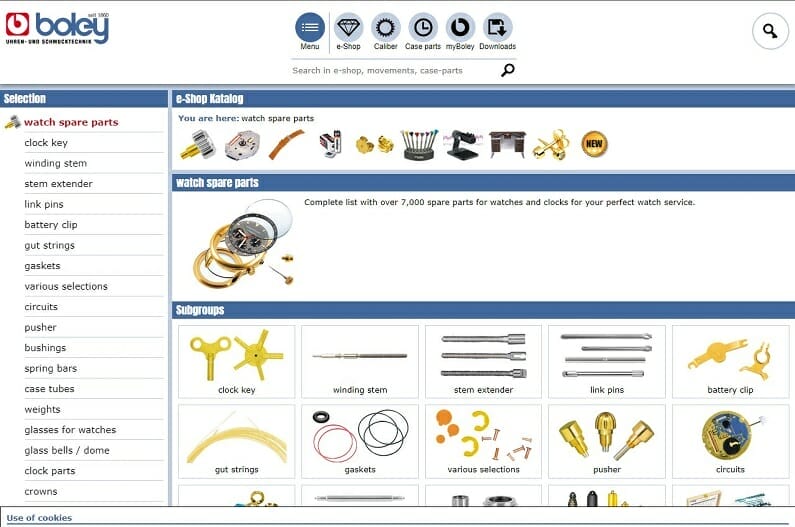
Boley Gmbh Parts Database
Boley is another great option that you could use to search for part numbers. Now you won’t be able to buy from them because they only sell to professional watchmakers, but that doesn’t prevent you from searching their database.
What’s great about Boley is that they have a lot of brands that you won’t find on Jules Borel’s database.
Buying Parts from Supply Houses
When it comes to buying watch parts, my choice is always going to be the supply houses. Here in the US, we’ve got supply houses that have been around for almost a hundred years.
Some of these companies are third, fourth generation family members. They have an incredible amount of experience behind them.
I will admit some are better than others as far as being helpful finding information. Back in the day, these guys dealt only with professionals. Because of the way the markets changed, they’ve had to open up their doors to hobbyists as well.
Advice on Contacting a Watch Supplier
If you’re going to contact them, I would definitely know exactly what you’re looking for because they’re not going to do the research to sell you a 5 dollar part.
You definitely have to know what you’re looking for. If you do, there’ll be more than glad to help, but you can’t call them up and say, “What size crystal do I need for this kind of watch” ? They don’t have time for that kind of stuff.
Some of suppliers are only going to deal with professional watchmakers, but the vast majority will sell to anybody that contacts them.
Sourcing Watch Parts from eBay
eBay can also be a great source for watch parts. Just be aware that a lot of sellers, don’t know jack about watches and they just have come across a gross of watch parts that are selling.
Double check your information, cross reference it and ask any questions if you have any doubts before you order it.
Buying Knock off Swiss Parts
You’re also going to see generic parts that are made by the Chinese for movements like ETA. My advice is stay away from them completely.
Here’s an example of a generic pallet for which is made for an ETA 2824. I got this just because I wanted to compare it to a factory part.
Luckily, I didn’t open the part to inspect it. I inspected it through the sealed container and if you look closely, you’ll notice that it’s completely missing the lower pivot.

If I had opened up this package, I wouldn’t have been able to say anything about it. They would have just said, well, you broke it when you were trying to put it in.
So personally, I would just stay away from that stuff.
Parts and Donor Movements
Part or Donor Movements are another great option. If you’re going to be working on a lot of the same movement or same brand, buying complete movements makes sense.
Not to mention the fact that new old stock parts are probably not even going to be available for vintage watches.
When you’re buying Donor Movements, it’s always best to buy a complete movement as the ones that are partial movements almost always have been picked and stripped of all the best parts.
In my experience, lots of donor movements sold together are a huge waste of time and money.
Part Lots
This refers to random parts like a bunch of wheels, a bunch of crystals or anything like that, they’re typically going to be stuff that you’re never going to use.
A lot of times eBay sellers will sit on this stuff, and they’ll try to sell it individually. If it doesn’t sell, they just put them in a big lot and try to sell them like that.
Those parts are for watches that nobody’s working on.
Watch Part Assortments: Good Assortments
Now the exception of this would be certain part assortments that you can buy from supply houses like gaskets, springs or screws.
If you work on a lot of dive watches, having an assortment of case back gaskets and crown gaskets would make perfect sense, instead of buying them just one at a time.
Movement Springs
One part that seems to go missing a lot are movement springs. Having an assortment of different styles of springs is almost a necessity as they can almost be impossible to find from suppliers and sometimes are only available when you buy a whole donor movement. Nobody wants to buy a whole movement for one spring.

Screws
You’re going to lose a screw or be working on a movement that’s missing a screw. Since buying a factory screw can almost cost as much as $5 plus shipping, having multiple assortments of watch screws is definitely going to end up saving you money in the long run.

Shock Spring Assortments
Another good one is assortments of shock springs. You’re going to run into shock springs that are damaged. Sometimes they won’t even hold the end-stone down properly and they’re going to need to be replaced.

Watch Part Assortments: Bad Assortments
Hairsprings
There are some parts assortments that you should absolutely stay away from.
The first would be hair springs. Other than using these hairsprings to practice on, buying lots is typically a waste of money for new watchmakers.
They need to have the correct collet, installed in the correct direction and the correct stud at the end of the hair spring and are the correct weight needed for that balance wheel, you’re never going to be able to use them in a watch movement.

If they’re just raw hair springs with no collet or stud they’re pretty much unusable for you at this point. If you want to learn how to pin collets and how to vibrate hair springs then go for it.
The one thing that I would suggest is if the price is low enough to get some raw hair springs or get any hair spring, it really doesn’t matter, then you can use these hair springs to practice your needling with.
Jewel Assortments
Another assortment I would stay away from is assortment of miscellaneous jewels.

Jewel assortments, unless they’re brand new, Seitz brand jewels, are typically made up of factory seconds that couldn’t be sold as new jewels that are going to be pretty much unusable to you unless you have the ability to shape them.
There’s also new Seitz jewel assortments. These are usually kept by production shops that work on all kinds of watches and never know what they’re going to get.
These assortments will have a bunch of sizes that you will probably never use, and they’re pretty pricey, so I wouldn’t invest in those.
Non-Factory Watch Parts
Mainsprings
Many of the parts that you need to source can simply be non-factory or generic parts.
And when I say generic, I’m talking about parts that are made by industry specialists,
not some poor-quality knockoff.
Generale Resortes is the industry leader for main springs. I’ll usually start off at Cousins UK if I’m looking for a particular size or an alternative to a size.

And then once I locate it, I now have the GR number and now I can search US suppliers, but oftentimes I just end up going back to Cousins anyway.
Watch Crystals
The two largest acrylic crystal suppliers are going to be GS supplies and Sternkreuz. Sternkreuz not only makes acrylic crystals, but they also make mineral and sapphire crystals as well.

Some Personal Favorite Suppliers
Acrylic Crystals
When it comes to acrylic crystals, my go-to company is tip top crystals. They have a huge inventory. These guys know acrylic crystals inside and out, and they have unbelievable customer service.
I have ordered crystals from them before, and actually they’ve thrown in an extra one of the same size just as a backup in case something happened with that particular crystal.
Who does that kind of thing anymore?
Balance Staffs
If I’m looking for a balance staff, there’s no better place to go than BalanceStaffs.com.
One of the great things about this website is they have a huge database of information on all manufacturers. When you pull up the balance staff, there’s actually drawings that give you the dimensions of all the different parts of the balance staff so that you can know that you’re getting the right size.
Mainsprings
When it comes to mainsprings, it’s got to be Cousins UK. You search by manufacturer, but you can also search by size. Sometimes when you’re looking for a mainspring and you know what size it should be, that mainspring is discontinued.

If you watch my video, How to Size Any Watch Mainspring to a Barrel, you will know how to select a size that will work. Then you’re able to look at all the available sizes to pick the one that’ll work for that watch.
Like I said, I’ll check my local suppliers, but if they don’t have it, I just go back to Cousins UK and get it there.
Professional Watch Part Supply Houses
Now when it comes to general parts, I usually start off with the top three in the US, Jules
Borel, which we have talked about, Otto Frei, and Cas-ker.
Like I said earlier, these guys have been around for almost 100 years, they have a huge
amount of experience huge inventories of parts.
If you’re in the UK, Cousins UK has a very large parts supply. They may actually even
be one of the largest parts suppliers in the world. They’re also huge advocates for “Right to Repair”, making parts available from the manufacturers to everybody.
So I like to support them as well.
Perrin Watch Parts
Another great supplier is PerrinWatchParts.com, which is a Canadian company.
They also have a huge inventory of parts and are also awesome guys to do business with.
Daves Watch Parts
If you’re in the US and you’re looking for obscure pocket watch parts, there’s probably
no better place than a website called Dave’s Watch Parts.
Now Dave’s an old school guy and he’s bought up inventories from other smaller watch supply
companies that went out of business over the years.
He has a huge inventory of stuff, more parts than he can actually put on his website. So if you’re looking for a pocket watch part for an American pocket watch, Dave will search his inventory and let you know if he has it.